Our Location
House no 99 , second floor , Block H-1 , sector 11 , Rohini , New Delhi , 110085 , INDIA

House no 99 , second floor , Block H-1 , sector 11 , Rohini , New Delhi , 110085 , INDIA

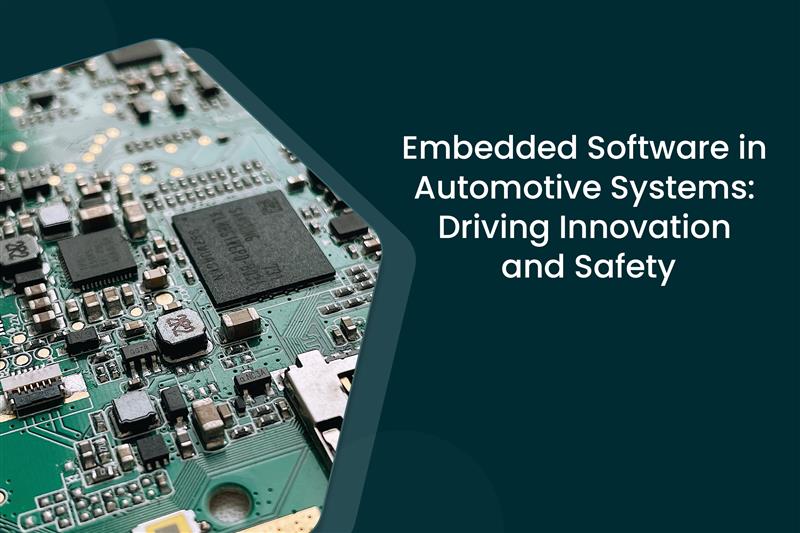
The automotive industry has traditionally been a hardware driven industry with mechanical and combustion engines running the vehicles. But in the era of changes, the embedded software has become one part attached to determining vehicle performance, safety and user experience. Embedded software are applications or computer programs that interface controlling code of a vehicle and determine the overall functioning of it.
Embedded software in automotive systems makes vehicles smart. Embedded software is a key factor for the future of mobility with the spread of electric and autonomous vehicles. In this blog, we are going to discuss the importance and significance of embedded software in automotive, how it enables functional advancements that make driving experience more safe and connected; eventually pushing vehicles towards becoming fully automated.
Today, embedded software systems can be found in virtually every vehicle apart from safety systems and engine control units (ECUs), to infotainment systems and battery management systems in electric vehicles (EVs). Embedded software becomes even more critical as we see the rise of more sophisticated, connected and driverless vehicles.
One of the most important trends in car technology in the last decade is the emergence of Advanced Driver Assistance Systems (ADAS). Such systems make use of embedded software as they do, and are used to enforce advanced safety applications which can help drivers in real time.
ADAS software processes sensor information, received from cameras, radar and LiDAR devices, and uses it to make decisions in a fraction of a second to keep drivers safe. These features are a critical step in the direction of semi autonomous driving that greatly minimise the chance of an accident due to human error.
When it comes to automotive, safety isn’t something you can compromise. Automotive embedded systems are key to enabling real-time control of vehicle operations, particularly in emergency situations. It works on safety systems such as airbag activation and engine control systems that require ultra dependable, real-time embedded software that responds with immediacy under pressure.
Critical location inside the vehicle, where embedded software provides reliability and safety in real-time are:
These systems are safety relevant and must be fail-safe. All of this hardware requires real-time data processing and action, faster than a human driver might respond which the embedded software part of these systems provides.
Connectivity and in-car entertainment also turned the end user experience inside vehicles to be great. The code that runs on it is known as ’embedded software’ and literally forms the brains and control centre of things like in-car infotainment ensuring everything from smartphones to voice assistants and media options run properly.
Among those being supported by embedded software in automotive systems are:
Smartphone Integration (Apple CarPlay, Android Auto): The in-car software bridges the connection for navigation, calls and music while messaging is available via voice control.
Voice Recognition: Programs that can understand natural language enable drivers to operate several vehicle features using speech, ultimately decreasing driver distraction and enhancing safety.
Over-the-Air (OTA) Updates: New age cars can get software updates over the air and have the newest features and security patches.
Connectivity also encompasses more than just infotainment, for vehicle-to-everything (V2X) communication allows cars to communicate with infrastructure and other cars in what promises to be a smarter, better traffic management system.
Powering the transition to electric and autonomous driving is one of the most paradigm-shifting transitions in automotive, with embedded software at its heart. Advanced embedded software is needed for electric vehicles to ensure battery performance, energy consumption and charge control are maximized.
The Battery Management System (BMS) monitors and guards the battery operation but also generates information on power consumption while software in the powertrain optimizes acceleration, braking and regeneration.
Self autonomous vehicles based on embedded software interpret data collected by a network of sensors, cameras and artificial intelligence (AI) for real-time navigation & decision-making capability. This includes motion planning, odometry and sensor fusion, path and obstacle detection and decision making for safe driving. Software is also involved in deciding vehicle speed, tackling traffic situations and making sure that there are no threats to passengers, pedestrians or other vehicles.
Autonomy software in vehicles is extremely complicated, and it’s changing on account of developments in AI, machine learning and sensors.
Risks of automobile hacking are growing as cars become more connected. Security enhancements are also required for embedded software in an automobile to prevent unauthorized access, and also ensure the integrity of a vehicle operation. Cybersecurity threats can go from a nasty hack of an infotainment system to much worse in control systems such as those for braking or steering.
As connected cars, both to the internet and each other, proliferate, automotive cybersecurity remains high on the agenda as a defence against new attack vectors.
Embedded software is here to stay in the automotive industry, driving innovation and the move to safety-critical systems as well as the growing trend of electric and autonomous vehicles. With the increasing connectivity and automation levels in vehicles, the call for trustworthy and real-time embedded systems is likely to play an even bigger role, introducing new claims but also openings.
Here at Dakshkanya, we know the digital side of product development is nothing to take it lightly. Leveraging our strong background in the software design services, we are committed to assisting automobile manufacturers and suppliers address the growing demand for innovative vehicles that are safe and secure.