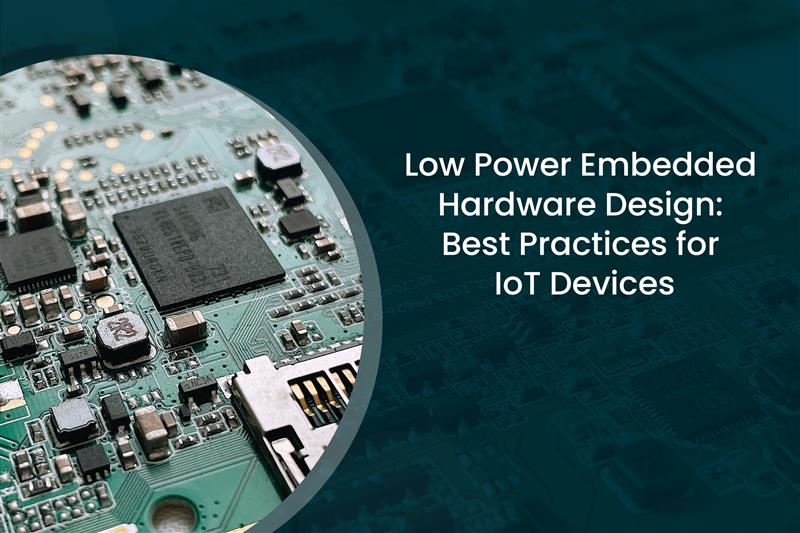
With the rising popularity of the Internet of Things (IoT), the requirement for low-power embedded hardware design systems increases drastically. IoT devices, sensors, wearables and smart home products, are usually battery powered, making energy efficiency a fundamental design consideration.
Need for Power Efficiency in IoT Devices
Power consumption is a vital consideration for IoT devices since they must function over long durations without frequent battery changes or recharges. Energy-saving embedded systems can vastly extend battery life, making them ideal for remote monitoring or health-tracking wearables.
Low-Power Design Techniques
Dynamic Voltage Scaling (DVS): DVS enables systems to change their voltage according to workload requirements, for low-intensity tasks, voltage decreases to reduce power consumption.
Efficient Microcontrollers: Choosing an appropriate microcontroller is key. Most modern MCUs like ARM Cortex-M and ESP32 are designed for low-energy usage. Features such as sleep modes and removal of non-essential components contribute to battery longevity.
Energy Harvesting: Some IoT setups use energy-harvesting solutions like solar panels or kinetic energy sources to boost battery output and reduce recharging frequency.
Sleep and Idle Modes: IoT devices mostly lie dormant in standby until they need to send or receive data, this is one of the most effective techniques for saving power.
Efficient Communication Protocols
Communication can be a serious energy drain in IoT devices. Low-power protocols include:
Zigbee, A low-power wireless protocol based on IEEE 802.15.4, designed for mesh networking in home automation and industrial applications.
LoRa, A long-range wireless protocol designed specifically for low-power wide area networks (LPWAN), suitable for remote IoT deployments.
Bluetooth Low Energy (BLE), Ideal for short-range applications like wearables and smart home devices.
Best Practices for Low-Power Embedded Design
Component Selection: Choose MCUs with ultra-low power modes, reliable sleep states and scalable clock speeds. Select sensors with energy-saving features and implement duty cycling. Use wireless modules such as BLE, Zigbee or LoRaWAN rather than traditional Wi-Fi or cellular.
Power Management Techniques: Use Dynamic Voltage and Frequency Scaling (DVFS) to reduce power during low load periods. Utilise MCU and peripheral sleep modes effectively. Turn off unused modules with power gating. Use high-efficiency voltage regulators matched to the system's power requirements.
Efficient Circuit Design: Choose high-grade PCB materials to minimise leakage currents. Use proper shielding, grounding and trace routing to minimise noise. Plan PCB traces and component layout to limit parasitic capacitance and switching energy consumption.
Testing and Optimisation: Use power analysers and oscilloscopes to profile power consumption across different modes. Optimise firmware to minimise CPU wake time, sensor polling and interrupt-driven designs.
Low-power strategies for IoT embedded systems are essential for sustainable and efficient long-term operation. By strategically specifying components for low power consumption and implementing intelligent power management, IoT designs can achieve excellent energy efficiency without sacrificing performance.
Have a project in mind?
Talk to our embedded design experts for a free consultation.
Get Free Consultation