Our Location
House no 99 , second floor , Block H-1 , sector 11 , Rohini , New Delhi , 110085 , INDIA

House no 99 , second floor , Block H-1 , sector 11 , Rohini , New Delhi , 110085 , INDIA

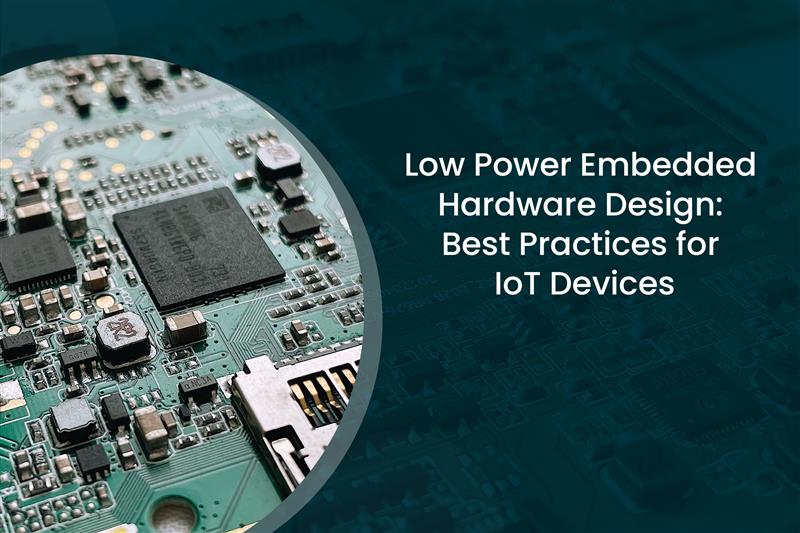
With the rising popularity of the Internet of Things (IoT) in the world, the requirement of low power embedded hardware design systems increases drastically. IoT includes sensors, wearables and smart home IoT devices, is usually battery powered and is a great design concept issue as it concerns energy efficiency.
In this blog, we’ll talk about the methods and properties of building low-power embedded systems for IoT applications.
Power consumption is a vital consideration for IoT devices since they must function over long durations without requiring frequent battery changes or recharges. Energy saving embedded systems can vastly extend the life of the battery, making them ideal for applications such as remote monitoring or health-tracking wearables.
DVS enables systems to change their voltage according to workload requirements. For low-intensity tasks, it can also decrease its voltage for reduced power consumption.
Choosing an appropriate microcontroller is key to keeping power efficient and must be considered during embedded system hardware design. Most modern microcontrollers, like ARM Cortex-M for example or ESP32, are designed for low-energy usage. Features such as sleep modes and removing non-essential components contribute to the longevity of batteries.
Some IoT setups use energy-harvesting solutions like solar panels or kinetic energy sources that can boost and keep battery output while reducing the need for frequent recharging.
The right combination of sleep and idle modes is one of the most basic techniques for saving power. IoT devices are mostly lying dormant in standby until they need to send data or receive sensor data or otherwise operate in live mode.
In IoT devices, communication can be a serious energy drain with low-power use cases to transmit data in IoT devices. So, protocols are designed such as Zigbee, LoRa, and Bluetooth Low Energy (BLE), where data is transmitted with the least amount of power.
Zigbee– A low power wireless communication protocol which is based on IEEE 802.15.4 standard and is a low power protocol.
LoRa- A long-range wireless communication protocol designed specifically for low-power wide area networks (LPWAN) wireless communication: This protocol can meet a wide variety of conditions of wireless communication in IoT applications.
IoT devices often rely on sensors, and with the right selection of low power equipment many potential improvements can be seen in operation efficiency. As per experts providing embedded hardware design service, a typical sensor is a passive infrared (PIR) sensor and a capacitive one which are used in low-energy systems.
PIR Sensors– They detect motion when a warm body enters the field of view—the infrared radiation within which they are trained is altered to show the infrared effect of motion by heat as it increases or decreases. PIRs require less energy to operate than ultrasonic and radar sensors.
Capacitive Sensors– These sensors detect objects by measuring differences in capacitance and are efficient in perceiving human touch, fluid concentration, nearness towards objects, and non-metallic things.
Minimising power usage is important; it shouldn’t harm the overall performance of the device. Designing solutions should find the middle ground where power efficiency and performance can coexist.
Another conundrum is reconciling the size of the individual batteries compared with the general IoT device size. The footprint of small-sized devices may inhibit the capacity of larger batteries that should be used in the device.
Low power design comes down to selecting the correct components. Key considerations include:
Low Power Microcontrollers (MCUs): Choose MCUs with ultra-low power modes, reliable sleep states, and scalable clock speeds to save energy during idle periods.
Efficient Sensors Choose sensors for low-power embedded hardware design that deliver accurate data and power-efficient operation. Energy-saving features onboard and sensor duty cycling minimize the impact on electrical power.
Power-Efficient Communication Modules– Wireless components such as Bluetooth Low Energy (BLE), Zigbee, and LoRaWAN are significantly less-consuming than traditional Wi-Fi or cellular technologies, allowing you lower power consumption.
Passive Components– Implement very low leakage capacitors and resistors for reducing quiescent current in the circuit.
By strategically specifying components intended for low power consumption, IoT designs can begin down a solid energy efficient path.
Power is key to extending battery life. Good power management:
Dynamic Voltage and Frequency Scaling (DVFS): Voltage & Frequency switching based on workload demands, in order to decrease the power cost during low load time.
Sleep and Deep Sleep Modes: Utilize MCU and peripheral sleep modes effectively. Your components should wake up only when needed.
Power Gating: Turn off unused modules or peripherals and eliminate leakage currents.
Efficient Voltage Regulators: Use low dropout regulators (LDOs) or switching regulators of high efficiency matched to the power requirements of the whole system.
Battery Management:- Use smart battery monitoring and charging circuits in order to guarantee the health of our batteries.
These methods enable the device to consume power only as required and to lead a long operation time.
A well-designed circuit can reduce power losses:
Minimize Leakage Currents: Choose high-grade PCB materials and design methods to minimize leakage areas.
Optimize Signal Integrity: By using appropriate shielding, grounding, and trace routing, noise and energy are minimized.
Minimize Parasitic Capacitance: It is critical to plan PCB traces and component layout which limits parasitic capacitance and hence the switching energy consumption.
Use Low Power Modes for Peripherals: Set peripherals to work efficiently, or drop them to low power mode when not in use.
Simplify the Design: Few components and simple interconnections minimize static and dynamic power usage.
Energy harvesting can either supplement battery energy or operate without batteries:
Solar Energy: Small photovoltaic cells can recharge batteries or directly power devices in bright environments.
Thermal Energy: Thermoelectric generators convert temperature gradients into electrical energy, suitable for industrial and wearable IoT nodes.
Vibration and Mechanical Energy: Piezoelectric or electromagnetic harvesters transform motion into power.
RF Energy Harvesting: By capturing ambient radio waves a trickle charge can be harvested. For ultra-low power applications in various technologies, the process is highly efficient.
Tests and optimization are essential to ensure power efficiency is the answer:
Power Profiling: Utilize specialized tools such as power analyzers and oscilloscopes to analyze the overall level of power consumption in various modes.
Code Optimization: Alter firmware to minimize CPU wake time, sensor polling, and utilize interrupt-driven designs.
Thermal Testing: Validate that temperature fluctuations do not lead to unexpected power spikes.
Low-power strategies for IoT embedded systems should be developed in order to attain sustainable and efficient operation in the long term. Designing an optimized device will not diminish the overall performance over time, along with the appropriate voltage management and smart low-power components.
To know more about this, reach out to experts at Daksh Kanya. We provide comprehensive embedded hardware design service.